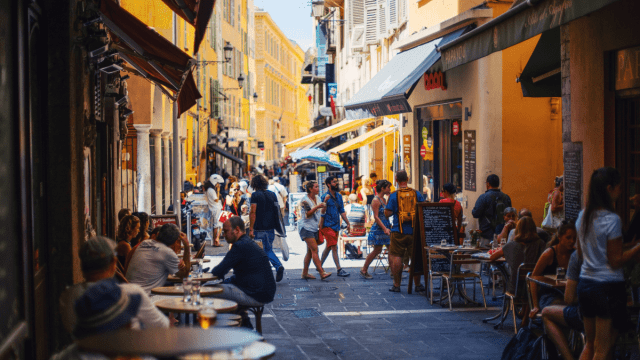
When you first start learning French, it is easy to get overwhelmed by long lists of textbook vocabulary. However, native speakers rely on a core set of highly versatile words to navigate their daily routines. These workhorse words appear constantly in casual chats, quick errands, and public interactions.
Mastering these ten essential words will help you move through daily life in France with confidence and ease.
Introduction
Building fluency in a foreign language does not require knowing every word in the dictionary. It comes from knowing the right words that carry maximum utility. In French, a handful of high-frequency words do the heavy lifting in everyday conversations. Whether you are greeting a neighbor, asking for help, or confirming a plan, these ten words are the foundation of practical, real-world communication.
Click here to become a fluent French speaker in record time.
1. Bonjour
This is the single most important word in the French language. It means good morning or hello, but its cultural role goes much deeper than a casual greeting. In France, saying bonjour is mandatory before asking a question, ordering food, or starting any interaction with a stranger or cashier. Skipping it is seen as impolite. You can use it simply by saying, “Bonjour, est-ce que vous pouvez m’aider ?” (Hello, can you help me?).
2. Merci
Politeness is central to French culture, and merci is your primary tool for showing appreciation. It means thank you. You will use it multiple times a day, whether someone holds a door, hands you a receipt, or serves your coffee. To add emphasis, you can say merci beaucoup, which means thank you very much. A simple example is, “Merci pour votre aide” (Thank you for your help).
3. S’il vous plaît
This phrase translates to please when addressing strangers, elders, or professionals. The literal translation is “if it pleases you.” Using it at the end of requests keeps your interactions smooth and respectful. If you are speaking casually to a friend or child, the phrase changes to s’il te plaît. You can deploy it easily by asking, “Un café, s’il vous plaît” (A coffee, please).
4. D’accord
This versatile phrase means okay or agreed. It is used constantly in spoken French to show that you understand what someone said or that you agree with a decision. It acts as quick conversational glue. When a friend suggests meeting at five o’clock, you can respond directly with, “D’accord, à tout à l’heure” (Okay, see you soon).
5. Pardon
When you bump into someone on a crowded train, need to squeeze past someone in an aisle, or do not hear what someone said, pardon is your go-to word. It means excuse me or pardon me. It is short, polite, and universally understood. For instance, if you need to pass someone on the stairs, you simply say, “Pardon, excusez-moi” (Pardon, excuse me).
6. Combien
When shopping, traveling, or dining out, you will always need to ask about prices and quantities. Combien means how much or how many. The most common phrase you will use in daily life is “C’est combien ?”, which means “How much is it?”. You can also ask, “Combien ça coûte ?” (How much does that cost?).
7. Où
Navigating a new city or store requires asking for directions. Où means where. You can combine it with the phrase “où est” to ask where something is located. Whether you are searching for a train station or a restroom, this word is essential. A practical sentence is, “Où se trouvent les toilettes, s’il vous plaît ?” (Where are the restrooms located, please?).
8. Quand
Time management and scheduling are key parts of everyday life. Quand means when. You will use it to ask about bus schedules, opening hours, or meeting times. For example, if you want to know when a shop opens, you can ask, “Quand est-ce que le magasin ouvre ?” (When does the store open?).
9. Pourquoi
When you need clarification, an explanation, or more details about a situation, pourquoi is the word you need. It means why. It helps you ask about reasons and causes in daily life. An example of its usage is, “Pourquoi le train est en retard ?” (Why is the train late?).
10. Désolé
This word means sorry. You use it when you make a mistake, arrive late, or need to express sympathy. Male speakers write it as désolé, while female speakers add an extra e at the end as désolée, though both are pronounced identically. You can use it in a sentence by saying, “Je suis désolé pour le retard” (I am sorry for being late).
Conclusion
Navigating daily life in French becomes much simpler once you lock these foundational words into your memory. Words like bonjour, merci, and s’il vous plaît open doors and ensure your interactions are always polite and effective. By integrating these ten vocabulary items into your daily speech, you lay a solid foundation for real-world confidence and fluency.
Click here to become a fluent French speaker in record time.
Read Our Recent Posts

Speak French In 3 Months
SpeakFrenchFast Academy
All Rights Reserved.