Introduction
Almost every language learner knows the exhausting feeling of having an internal translator running non-stop. A French speaker asks you a simple question. Before you can answer, your brain grabs the French sounds, converts them into English words, figures out what they mean, writes an English reply, and translates that reply back into French. By the time your mouth opens to speak, the conversation has already moved on.
This habit feels natural at first because English is your safety blanket. But running every single thought through a two-way mental bridge is slow, tiring, and limits your fluency. To speak French naturally and keep up with real conversations, you must teach your brain to connect French directly to real life, bypassing English entirely.
Click here to become a fluent French speaker in as little as 3 months time.
1. Why Mental Translation Holds You Back
Translating in your head causes two major problems. The first is speed. Human conversation moves very fast. If your brain has to perform four separate translation steps for every phrase, your mental processor runs out of steam quickly. You end up feeling drained after just five minutes of simple small talk.
The second problem is that languages do not map onto each other word for word. English and French build thoughts differently. If you translate literally from English, you will say things that sound strange to a French ear. For instance, in English, you say “I miss you.” If you translate that directly, you might say Je manque toi, which makes no sense in French. The French thought is Tu me manques, which literally means “You are missing from me.” Thinking in French means adopting French patterns instead of forcing English ideas into French disguises.
2. Connect Words to Images, Not English Words
When you see an apple, you do not think of the English letters A-P-P-L-E before you understand what it is. You instantly picture the round, red fruit, its sweet taste, and its crisp bite. The concept lives in your mind as an image and a sensation, not just a label.
You need to build that exact same direct link with French. When you learn the word la pomme, do not connect it to the English word “apple.” Instead, picture the physical fruit in your hand, or look directly at an apple on your kitchen table while saying la pomme out loud. If you use flashcards, use pictures instead of English translations on the back. When you attach foreign words straight to physical objects and feelings, you cut English out of the loop completely.
3. Learn Complete Chunks Instead of Single Words
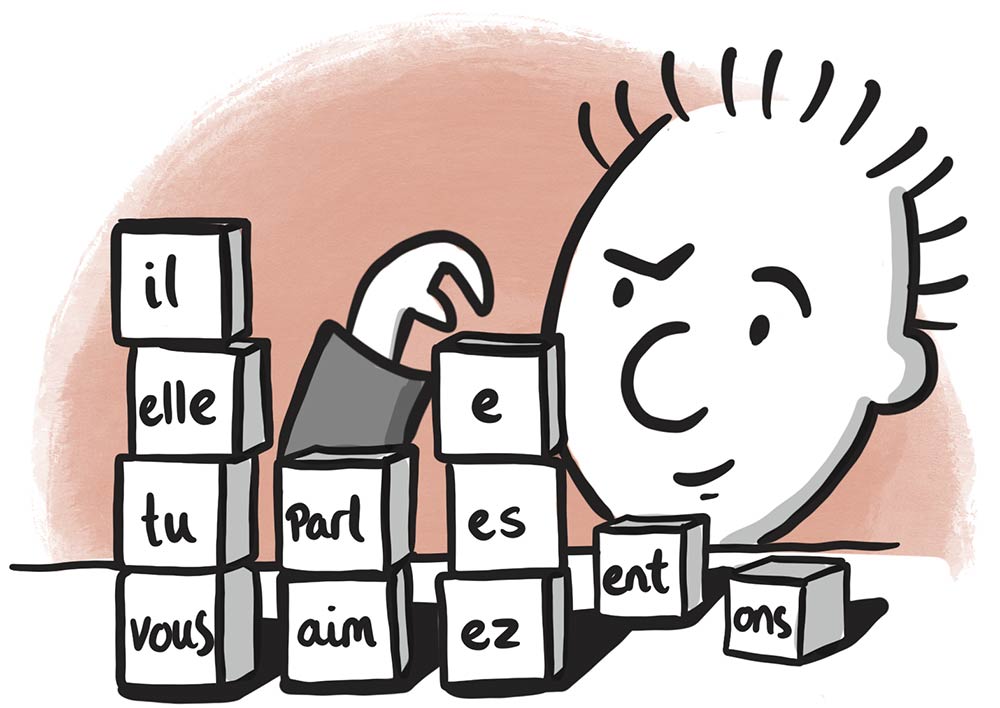
Memorizing isolated words invites your brain to act like an English dictionary. When you learn single words in a vacuum, you are forced to use English grammar rules to glue them together into sentences.
A much better way is to learn whole, ready-made phrases. Instead of learning the verb avoir (to have), the noun faim (hunger), and trying to remember that French uses “having hunger” instead of “being hungry,” simply memorize the whole chunk J’ai faim. When you learn whole blocks of speech, you do not need to analyze the grammar or translate the parts. The entire block fires off in your brain as a single, automatic reflex whenever your stomach starts rumbling.
4. Talk to Yourself in Simple French All Day
You do not need to book a flight to France or hire a private tutor to immerse your mind in the language. You have an inner voice talking in your head from morning to night. Giving that voice tiny French assignments is one of the quickest ways to build direct thought habits.
Start narrating your daily routine using simple words you already know. When you wake up, think Je me lève instead of the English phrase. When you brew your coffee, whisper Je fais du café. When you look out the window, tell yourself Il fait beau. Keep the sentences short and easy. The goal is not to write poetry; it is to get your brain used to operating in French mode during mundane moments of your day.
5. Consume French That Is Easy to Understand
Many learners try to jump straight into watching French news channels or reading classic novels. Because the material is far too hard, their brain has no choice but to reach for a dictionary and translate every word just to survive.
To break the translation loop, you must consume easy content. Pick beginner podcasts, children’s books, or simple dialogue videos where you already understand eighty to ninety percent of what is happening. When the content is easy, your brain relaxes. It absorbs the message naturally without needing to pause, decipher, or translate through English. Over time, this natural exposure trains your subconscious to understand French directly.
Conclusion
Stopping mental translation is not something that happens overnight, but it is entirely within your reach. By attaching French words directly to images, memorizing complete phrases, narrating your daily actions, and enjoying easy French content, you will slowly silence your internal English translator. Be patient with your brain, practice a little every day, and soon you will find yourself thinking, reacting, and speaking in French without even realizing you made the switch.
Click here to become a fluent French speaker in as little as 3 months time.
Read Our Recent Posts
Speak French In 3 Months
SpeakFrenchFast Academy
All Rights Reserved.