Introduction
Every language has pairs of words that look almost identical, share similar translations, or sound dangerously close out loud. In French, these vocabulary twins cause constant stumbling blocks for beginners. You reach for a word you think you know, only to discover that you accidentally picked its tricky twin and changed the meaning of your entire sentence.
Getting these words mixed up is a natural rite of passage for every new learner. However, remaining stuck on them leads to awkward hesitation and funny misunderstandings. By looking closely at the fifteen most common French words that beginners mix up, you can clear away the confusion and use each term with total accuracy.
Click here to become a fluent French speaker in 3 months or less
1. Jour versus Journée, and An versus Année
One of the earliest hurdles beginners face is choosing between short masculine time words and their longer feminine counterparts. You see le jour and la journée, as well as un an and une année, and both pairs translate simply to “day” and “year” in English.
The difference comes down to whether you are counting a unit of time or describing an experience. The short words jour and an are mathematical units. You use them when counting numbers, such as trois jours (three days) or cinq ans (five years). The longer feminine words journée and année describe the duration and everything that happened during that time. That is why you say Passe une bonne journée (Have a good day) and describe une belle année (a wonderful year).
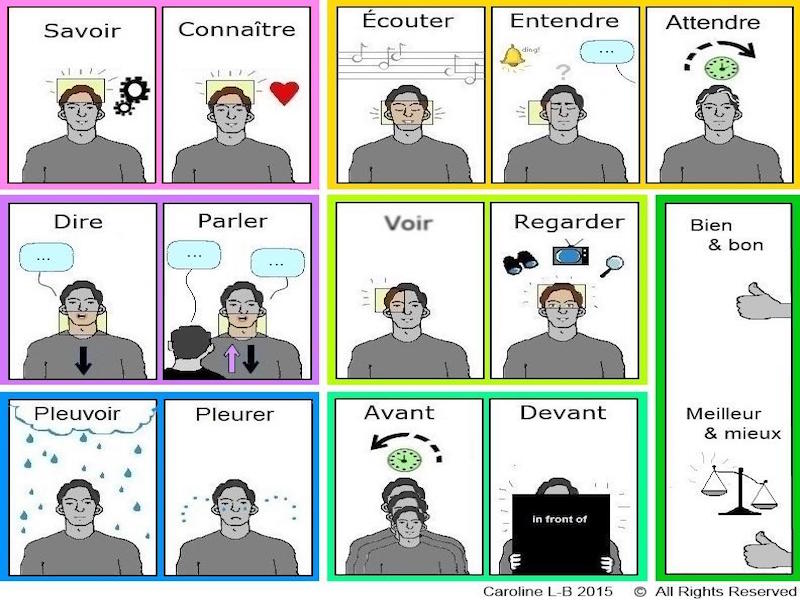
2. Écouter versus Entendre
In English, we have “listen” and “hear,” but because both actions involve the ears, beginners frequently mix up écouter and entendre.
Écouter is an active, deliberate choice. It requires conscious attention. You actively choose to écouter de la musique (listen to music) or écouter le professeur (listen to the teacher). On the other hand, entendre refers to passive hearing. It describes sounds that enter your ears whether you want them to or not. If someone drops a plate in the kitchen while you are reading in another room, you say J’ai entendu un bruit (I heard a noise).
3. Voir versus Regarder
Just like the ears have two verbs, your eyes have a similar pair that trips learners up: voir and regarder.
Voir means simply to see. It is an involuntary sensory perception. If you open your eyes in the morning, you see the ceiling: Je vois le plafond. By contrast, regarder means to look at or to watch with intention. You deliberately look at a photograph (regarder une photo) or sit down on the couch to watch a movie (regarder un film). Mixing them up can make your descriptions sound oddly robotic.
4. Visiter versus Rendre Visite À
When you want to say that you are visiting someone in French, your first instinct is usually to grab the familiar verb visiter. This is one of the most common false friend traps in the language.
In French, you only use visiter for physical places, buildings, monuments, and cities. You can visiter Paris, visiter un musée, or visiter un appartement. You cannot use visiter for human beings. When you visit a friend, a doctor, or your grandparents, you must use the longer verbal phrase rendre visite à, as in Je rends visite à mes parents (I am visiting my parents). Using visiter on a person makes it sound like you are inspecting them like a piece of real estate.
5. Partir, Quitter, and Laisser
English uses the single verb “to leave” in almost every situation. You can leave a party, leave a friend behind, or leave your keys on the table. French, however, splits this idea into three distinct verbs: partir, quitter, and laisser.
Partir means to leave or depart in general, and it does not take a direct object. You simply say Je pars (I am leaving). Quitter means to physically exit a specific place or separate from a specific person, requiring a direct object: Je quitte la maison (I leave the house) or Il a quitté sa copine (He left his girlfriend). Finally, laisser means to leave an object behind or let something stay where it is: J’ai laissé mes clés sur la table (I left my keys on the table).
6. Attendre versus Assister
This pair catches learners because both words look like familiar English terms, but their meanings do not match.
Attendre looks like the English word “attend,” but it actually means “to wait for.” When you are standing at a bus stop, you say J’attends le bus. If you want to say that you attended a concert, a meeting, or a class, the verb you need is assister à, as in J’ai assisté à la réunion. Confusing these two can cause you to say you waited for a conference instead of saying you were sitting in the audience.
7. Savoir versus Connaître
Both savoir and connaître translate to the English verb “to know,” creating endless debate for beginner students.
The general rule is practical and clean. Use savoir when you know facts, pieces of information, or how to do an action. It is almost always followed by a verb in the infinitive or question words like where, when, and how: Je sais nager (I know how to swim) or Je sais où il habite (I know where he lives). Use connaître when you are personally familiar with a person, a place, or a thing, and it is followed directly by a noun: Je connais Sarah (I know Sarah) or Je connais bien cette ville (I know this city well).
Conclusion
Mixing up similar French words is not a sign that your memory is failing; it simply means you are discovering where French makes finer distinctions than English. By paying attention to whether an action is active or passive, whether you are dealing with places or people, and whether you are counting units or describing experiences, the confusion quickly fades. Practice these fifteen terms in simple, real-world sentences, and your French vocabulary will become sharper, cleaner, and far more natural.
Click here to become a fluent French speaker in 3 months or less
Read Our Recent Posts

Speak French In 3 Months
SpeakFrenchFast Academy
All Rights Reserved.