Introduction
When you are tracking deadlines for business projects or organizing travel itineraries in a French-speaking country, knowing how to accurately read dates, time, and calendars is absolutely critical. It seems like a simple task, but a small misunderstanding can lead to a missed flight, an abandoned business meeting, or an incorrect project launch date.
A direct translation of English scheduling habits into French often fails because the structures run on completely different formatting tracks. French culture uses a highly standardized, logical blueprint for tracking time. To manage your schedule flawlessly and avoid costly professional mistakes, you must master the native conventions of the French calendar.
Click here to become a fluent French speaker in record time
The Order of the Calendar: Day/Month/Year
In the international business world, date formatting varies wildly. While the United States commonly uses the Month/Day/Year format, France and the rest of the French-speaking world strictly use the Day/Month/Year (DD/MM/YYYY) structure.
- The Trap: If you see the numerical date 04/07/2026 on a French invoice or contract, an English speaker might read it instinctively as April 7th. In French, this is a major error. That date is strictly the 4th of July.
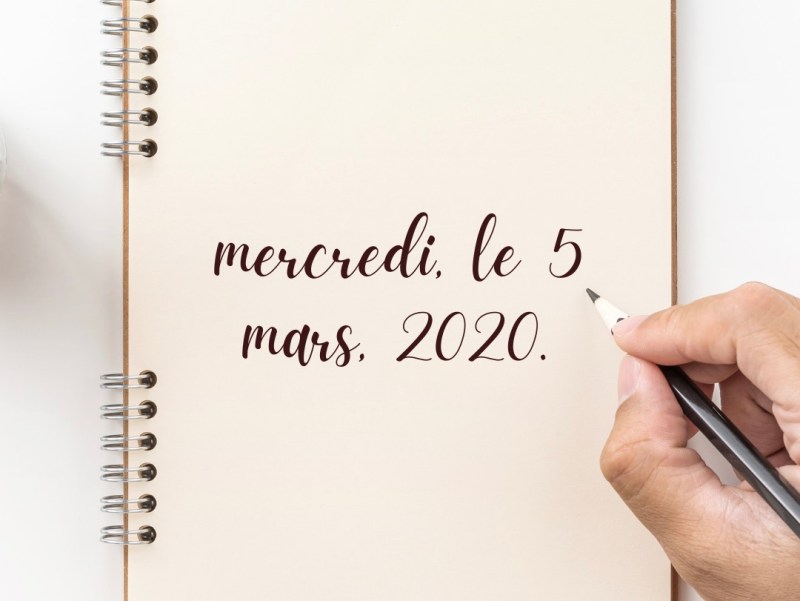
- The Blueprint: When writing out dates using words, you never use ordinal numbers (like “second,” “third,” or “fourth”) as you do in English. You use standard cardinal numbers preceded by the definite article le. For example, July 14th is written simply as “le 14 juillet”.
- The Sole Exception: The only day of the month that uses an ordinal number is the first day of the month. You write “le 1er mai” (the first of May), pronounced le premier mai.
The French Calendar: No Capital Letters, Mon-Start
When writing out the days of the week or the months of the year in French, you must drop an English grammatical habit: never capitalize them unless they are the very first word of a sentence.
- The Calendar Layout: On a standard French calendar track, the week begins on lundi (Monday), not Sunday (dimanche). This is crucial to remember when reading project timelines or booking weekend accommodations.
- The Vocabulary Chunks: Memorizing the lowercase sequences ensures you maintain professional writing decorum in emails and texts:
- Days: lundi, mardi, mercredi, jeudi, vendredi, samedi, dimanche.
- Months: janvier, février, mars, avril, mai, juin, juillet, août, septembre, octobre, novembre, décembre.
Mastering the 24-Hour Clock (L’Heure Militaire)
In casual conversation, French speakers might use twelve-hour shortcuts, but for any formal, corporate, or transport-related schedule, the 24-hour clock is the absolute rule. There are no native equivalents for “AM” or “PM.”
- The Notation: French does not use a colon to separate hours and minutes. Instead, it uses the letter h (standing for heure). For example, 4:30 PM is written precisely as 16h30.
- Reading It at Native Speed: To read or say a time out loud, you simply say the hour number, the word heure(s), and then the minute number.
- 08h15 \rightarrow huit heures quinze (8:15 AM)
- 14h00 \rightarrow quatorze heures (2:00 PM)
- 20h45 \rightarrow vingt heures quarante-cinq (8:45 PM)
- Casual Traps to Avoid: While phrases like et quart (and a quarter) or et demie (and a half) are fine for casual chats, stick strictly to the exact minute numbers (quinze, trente) when dealing with 24-hour business structures past 12h00. Saying “quatorze heures et demie” sounds highly unnatural; say quatorze heures trente.
High-Velocity Shortcuts for Deadlines
When navigating professional emails, you will often need to arrange meetings relative to the current day. Using pre-fabricated native chunks allows you to pitch availability without mental lag.
- Avant-hier / Après-demain: “The day before yesterday” (avant-hier) and “the day after tomorrow” (après-demain) are used constantly to set boundaries.
- En quinze: If a French colleague tells you a project is due “mardi en quinze”, they do not mean in fifteen days from Tuesday. It is a native idiom meaning “two weeks from Tuesday.” If they mean next week, they will say “mardi prochain”.
Conclusion
Reading French dates and time is a matter of shedding your native formatting lenses and committing to a highly logical, military-grade system. By locking in the Day/Month/Year order, keeping calendar terms lowercase, and training your ear to process the 24-hour clock instantly, you completely protect yourself from scheduling chaos. Stop calculating the time back into a 12-hour format and accept the precision of the system.
Click here to become a fluent French speaker in record time
Read Our Recent Posts

Speak French In 3 Months
SpeakFrenchFast Academy
All Rights Reserved.