Introduction
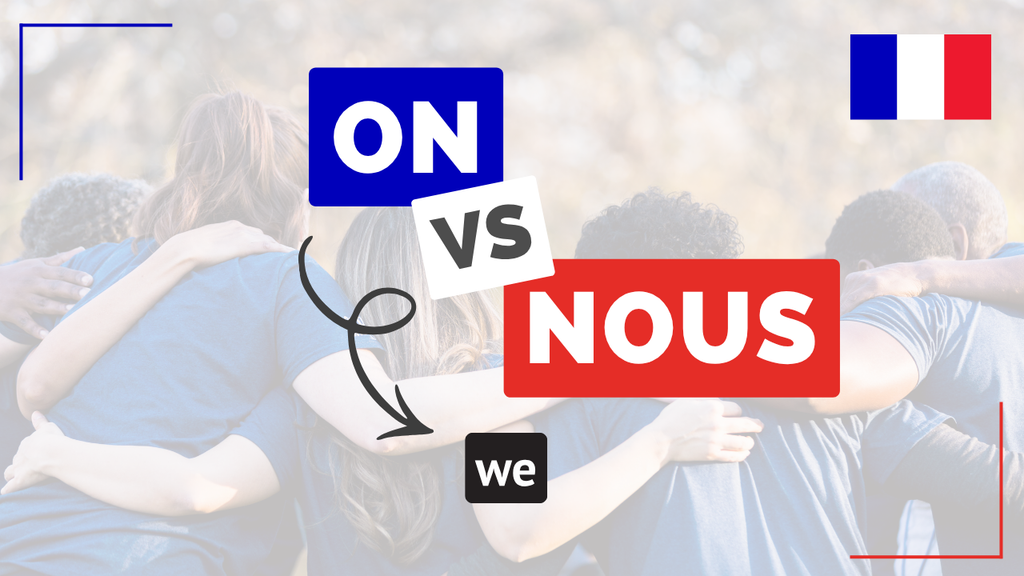
If you open any standard French textbook, the plural pronoun section always looks neat and organized. You are taught that je means I, tu means you, and nous means we. You spend hours memorizing long conjugations with the classic ending -ons, such as nous parlons, nous allons, and nous mangeons.
Then, you listen to native speakers chatting on the streets of Paris, hanging out in Montreal, or talking in movies, and nous is nowhere to be found. Instead, everyone keeps using the tiny two-letter word on. This leaves many learners wondering why native speakers ignore what the textbooks teach. Understanding why on took over the spoken language will make your French sound immediately more natural and cut your mental workload in half.
Click here to become a fluent French speaker in 3 months or less
1. The Original Identity of “On”
To understand why on is so popular, it helps to look at where it came from. Historically, on comes from the Old French word homme, meaning man or human being. In formal written French, it originally functioned as an indefinite pronoun, similar to saying “one,” “someone,” or “people in general” in English.
You still see this traditional use in proverbs and formal signs. A sentence like En France, on mange bien translates to “In France, people eat well” or “In France, one eats well.” It refers to people in an open, general way without pointing to a specific individual. Over the centuries, however, everyday speakers began adopting this flexible little word for a much more personal purpose: replacing nous entirely.
2. Spoken Efficiency and Speed
Language naturally evolves toward simplicity and speed. When people talk casually with friends and family, their vocal muscles prefer shortcuts over long, formal pronunciations.
Comparing the physical effort needed to say nous versus on reveals why this shift happened. To say nous allons, you have to pronounce three or four distinct syllables, navigate a formal liaison sound (nou-zallons), and use a longer verb ending. By contrast, saying on va takes two tiny, effortless syllables that roll off the tongue in a fraction of a second. Spoken French loves rhythm, economy, and speed, and on is the ultimate shortcut for modern conversation.
3. The Relief of Simpler Conjugations
Beyond speed, on offers a massive grammatical shortcut that native speakers and language learners alike appreciate. Even though on means “we” in casual conversation, it grammatically behaves like a singular third-person pronoun, sharing the exact same conjugation slot as il (he) and elle (she).
This means that when you use on, you never have to remember tricky, irregular -ons endings. Instead of worrying about irregular verb forms, you simply use the standard singular forms you already know best: on est instead of nous sommes, on a instead of nous avons, and on fait instead of nous faisons. Using on dramatically reduces the mental effort required to put a sentence together during a fast chat.
4. Tone and Social Warmth
Pronouns carry social signals, and using nous out loud often creates an accidental wall of formality between you and your listener.
In modern everyday French, saying nous in a casual setting can make you sound stiff, aloof, or like a politician giving a televised speech. It sounds like someone saying “we shall depart shortly” instead of “we’re heading out.” Using on instantly signals friendly warmth, equality, and casual comfort. When you suggest On va au resto ce soir ?, it feels relaxed, inviting, and natural.
5. When “Nous” Is Still Necessary
Adopting on for your casual speech does not mean you should throw nous away completely. The formal pronoun still plays essential roles in both written and spoken French.
You will encounter nous constantly in written French, including newspapers, academic essays, literature, and official government correspondence. It is also standard in formal corporate environments, business presentations, customer support interactions, and high-level job interviews where professional distance is required. Additionally, nous remains mandatory as an emphatic stress pronoun or when paired with prepositions, such as in the phrases C’est pour nous (It is for us) or Venez avec nous (Come with us).
6. How to Switch Your Speech Habits
If you have spent months drilling nous conjugations, your brain might default to it out of habit. Making the transition to on requires deliberate practice in your daily speaking routines.
Whenever you talk to yourself, practice daily inner narration, or do speaking exercises, force yourself to use on for every collective action. When cooking dinner with a friend, think on prépare à manger. When heading out the door, whisper on y va. The moment you start treating on as your default spoken pronoun for “we,” your speech will lose its stiff classroom edge and blend right into everyday native rhythms.
Conclusion
The widespread use of on instead of nous is not bad grammar; it is a natural, living evolution of spoken French. Choosing on gives your sentences greater speed, simplifies your verb conjugations, and brings a relaxed, authentic warmth to your conversations. Save nous for professional emails and formal essays, embrace on when chatting with peers, and enjoy speaking the vibrant French heard in real life every day.
Click here to become a fluent French speaker in 3 months or less
Read Our Recent Posts
Speak French In 3 Months
SpeakFrenchFast Academy
All Rights Reserved.