Introduction
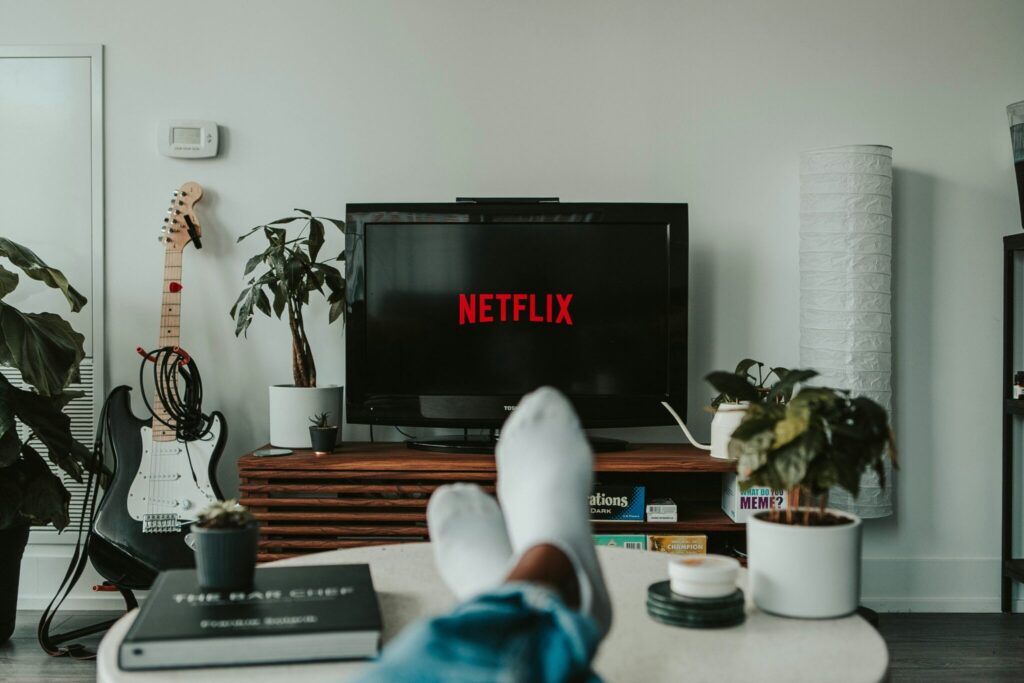
Many learners spend hours on Netflix with French audio and English subtitles, convinced that the language will eventually “sink in” through a sort of linguistic osmosis. Unfortunately, for most students, this is a form of passive entertainment rather than active learning. Because your brain naturally follows the path of least resistance, it will ignore the complex French audio and focus entirely on the easy English text.
To reach B1 independence, you need to stop “watching” and start “training.” You must turn your screen time into a high-intensity immersion session that forces your brain to engage.
Click here to speak fluent French in as little as 3 months time
The “Subtitle Trap”
When you watch with English subtitles, your brain is in “reading mode,” not “listening mode.” You are processing the story in your native language while the French audio becomes mere background noise.
- The Problem: You aren’t training your ear to catch the Big Four (être, avoir, faire, aller) in fast-paced speech; you are just enjoying a translation.
- The Fix: Switch to French subtitles. This creates a powerful neurological link between the sound you hear and the spelling on the screen. If that feels too overwhelming, try watching a movie you already know by heart in English, but switch both the audio and the subtitles to French. Since you already know the plot, your brain can focus entirely on the language.
The “Salami” Method (Active Slicing)
The biggest mistake is trying to watch a two-hour movie in one sitting. Your brain will reach a “saturation point” after about fifteen minutes, after which you stop learning and start just “hearing noise.”
- The Tactic: Take a two-minute scene and treat it like a laboratory experiment. Watch it once for the general story, once with French subtitles to identify the chunks, and a third time while using the shadowing technique to mimic the characters’ delivery.
- The Impact: Mastering two minutes of real, fast-paced dialogue is worth more than “hearing” two hours of content you didn’t actually process.
The Scavenger Hunt for High-Frequency Chunks
Stop trying to understand every single word. Instead, go into every viewing session with a specific mission. Treat the movie like a scavenger hunt for the most useful parts of the language.
- The Goal: Listen specifically for how the characters use the Big Four verbs in emotional or casual contexts.
- The Result: When you hear a character shout “On y va !” (Let’s go!) or “Qu’est-ce que tu fais ?” (What are you doing?), that is a piece of language you can use immediately. These “live” examples stick in your memory much better than examples found in a textbook.
The One Percent Rule for Screen Time
Consistency is the engine of speed. You don’t need to dedicate a whole evening to a cinema marathon to see results.
- The Habit: Use the one percent rule to commit to ten minutes of “Active Watching” every day. This could be a short YouTube clip from a French creator or one scene from a series.
- The Consistency: Doing this daily builds the “ear” required for B1 independence far faster than an occasional weekend movie session. It keeps your brain “tuned” to the French frequency so that the language never feels like a stranger.
Conclusion
Movies and series are incredible tools for fluency, but only if you use them actively. By ditching the English subtitles, slicing your content into manageable segments, and hunting for functional chunks, you turn a passive hobby into a powerful learning machine. You don’t need more content; you need more engagement with the content you already have.
Click here to speak fluent French in as little as 3 months time
Read Our Recent Posts
Speak French In 3 Months
SpeakFrenchFast Academy
All Rights Reserved.