Introduction
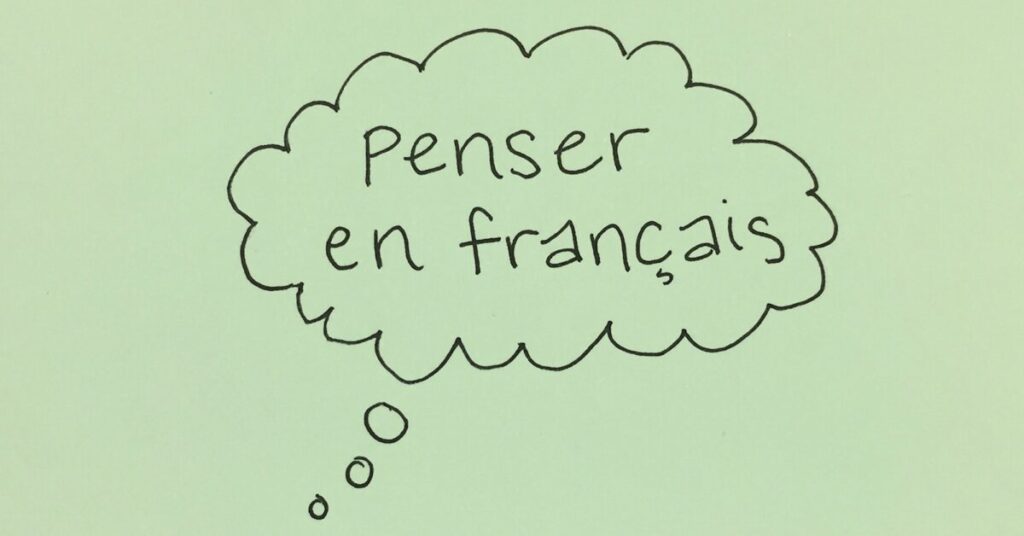
The “holy grail” of language learning is that moment when you stop translating in your head and start simply existing in the language. Most learners believe this is a mystical gift that only happens after years of living in France. In reality, thinking in French is a cognitive habit that you can begin building today, even if you are still at a beginner level.
To reach B1 independence, you have to stop treating French as a code you are trying to crack and start treating it as the primary operating system for your thoughts.
Click here to speak fluent French in as little as 3 months time
The Translation Trap
When you think in English and then translate to French, you are using double the brainpower. You are also forcing your brain to stay anchored in English logic, which is why your French often feels clunky or “off.”
- The Problem: Your brain is naturally lazy, it wants to take the path of least resistance, which is always your native tongue.
- The Fix: You have to make French the “easiest” path for simple thoughts. You do this by creating direct links between an object or an action and the French sound, bypassing the English word entirely.
The “Labeling” Method
Start with your immediate environment. Instead of looking at an object and thinking “Table… okay, the French word is la table,” you must look at the object and immediately trigger the sound la table.
- The Strategy: Use the Big Four (être, avoir, faire, aller) to create “thought loops” about your surroundings.
- The Exercise: As you walk through your house, don’t just name objects. Use a verb. “C’est une chaise” (It is a chair), “J’ai mon téléphone” (I have my phone).
- The Benefit: By attaching a verb to the noun, you are creating a complete thought. This is the “seed” of thinking in French. You are training your brain to categorize your world using French structures.
Use Chunks as Mental Shortcuts
Thinking in French doesn’t mean having complex philosophical debates with yourself. It means having “pre-loaded” reactions to life.
- The Tactic: Adopt chunks for your most common emotions or reactions. Instead of thinking “I’m tired,” train your brain to automatically trigger “Je suis fatigué.” Instead of “What’s that?”, trigger “C’est quoi ?”
- The Result: When these chunks become your “default” settings, your brain stops asking for an English translation. The French sound becomes the thought itself.
The Shadowing Technique for “Mental Echo”
The shadowing technique is vital here because it creates a “mental echo.” When you mimic a native speaker at high speed, you don’t have time to translate. You are forced to process the meaning and the sound simultaneously.
- The Goal: After a shadowing session, you will often find that the phrases you practiced keep “playing” in your head like a song.
- The Outcome: This internal playback is your brain thinking in French. It is the language taking up residence in your subconscious.
The One Percent Rule: The “French Only” Zone
Consistency is the engine of speed. You don’t need to think in French all day, you just need to carve out a sacred space for it.
- The Habit: Use the one percent rule to designate a specific “French Only” zone in your day. This could be while you are brushing your teeth, driving to work in Ibadan, or making breakfast.
- The Rule: For those five minutes, English is “forbidden” in your head. If you don’t know the French word for something, describe it using the Big Four or just point at it in your mind and say “C’est ça” (It’s that).
- The Impact: This daily “sprint” builds the mental stamina required for B1 independence. You are teaching your brain that it can survive and function without English, which removes the fear and the “friction” from your speech.
Conclusion
Thinking in French isn’t a destination you reach, it is a muscle you flex. By labeling your world, using the Big Four as your mental skeleton, and using the one percent rule to create daily “no-English” zones, you rewire your brain for fluency. You stop being a visitor in the language and start becoming a resident.
Click here to speak fluent French in as little as 3 months time
Read Our Recent Posts
Speak French In 3 Months
SpeakFrenchFast Academy
All Rights Reserved.